
Countdown to Election Day: 92 Days
At the “C” Club, we back candidates who can tackle the most complex issues and advance the ball down the field towards fiscal responsibility, smaller but more effective governance, and greater economic opportunity. In this month’s newsletter, we take a look at some of the biggest policy fights in both Washington and Austin.
The Latest from Washington
Although Republicans control both the House and the Senate, it is an understatement to say the two don’t always move in concert with one another. While the House continues to advance President Trump’s agenda, legislation has moved more slowly in the Senate, where Republicans must navigate a completely different set of circumstances and procedural hurdles.
Nowhere has this been more evident than with consideration of the election integrity legislation called the SAVE America Act. The House has passed key election integrity provisions supported by President Trump multiple times, but the Senate remains the roadblock. While House Republicans can advance legislation with a simple majority, the Senate’s 60-vote filibuster threshold means Republicans must either secure Democratic support or find another procedural path—something that has proven difficult.
The House even recently advanced the annual National Defense Authorization Act (NDAA), which includes $1 trillion in defense spending, with provisions of the SAVE America Act attached. By all accounts to date, this version of the NDAA remains dead on arrival in the Senate. Senate Democrats have blocked debate on the NDAA, and the legislation is in limbo heading into the fall.
The Latest from Austin
Arguably the biggest policy story coming out of Austin right now revolves around the fight over data centers. Texas spent years competing for data centers with tax incentives and a light regulatory touch. Now, lawmakers from both parties are questioning whether the state went too far.
Governor Abbott has already directed the Public Utility Commission (PUC) and ERCOT to ensure that new data centers—not residential customers—bear the costs of the electric infrastructure they require. Meanwhile, a Texas Senate committee spent last week examining whether the state’s 2013 data center tax exemption still makes sense. Several lawmakers from both parties indicated they’re open to repealing or substantially narrowing it.
The Latest from the Campaign Trail
With so many important policy fights underway, it is critical to remember that those who win elections are the ones who get to make the rules.
Republicans are united heading into the fall. Governor Abbott posted this picture last week on X, announcing this was the first time ever all statewide Republican candidates (not including judicial candidates) gathered together to “chart the course to victory in November.”
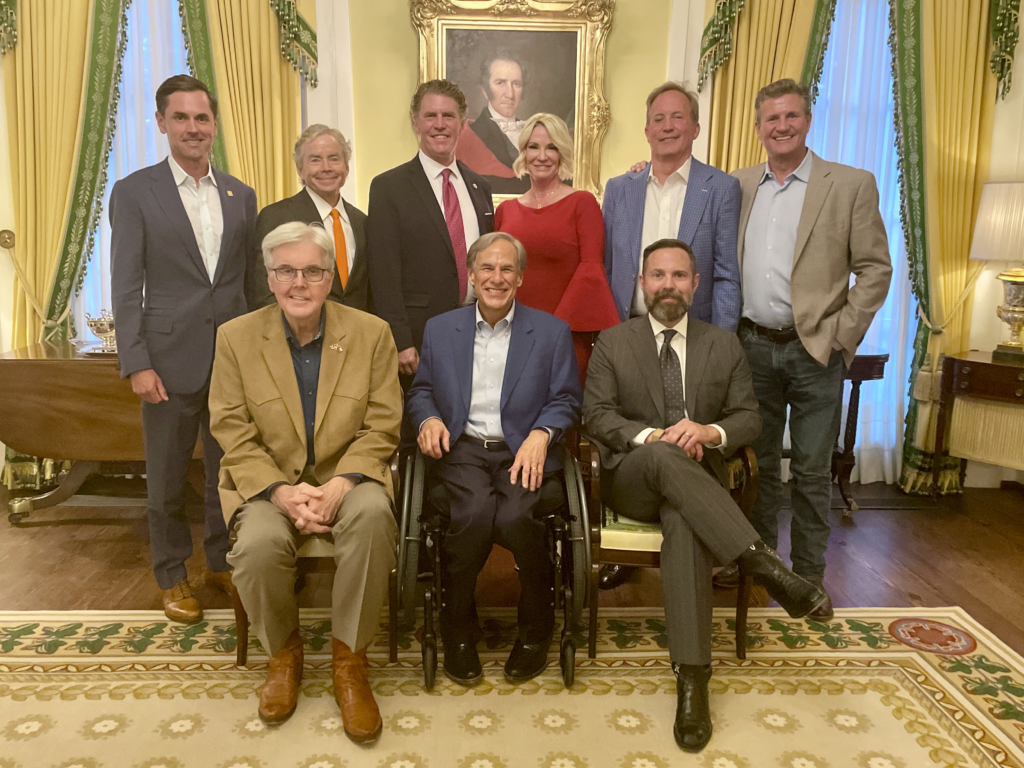
Front (L-R): Dan Patrick (Lt. Governor nominee), Greg Abbott (Governor nominee), Dustin Burrows (Texas House Speaker).
Aside from our statewide contests, there are at least four congressional races in Texas that could see considerable outside spending from national Republican and Democrat groups. This includes Republican Congresswoman Monica De La Cruz’s TX-15 seat, the newly redrawn TX-35, where Carlos De La Cruz is the Republican nominee, as well as the two blue seats in South Texas (TX-28 and TX-34). Furthermore, national Democrats are targeting 15 Texas state legislative seats, including those of Lacey Hull and Mano DeAyala. This is, of course, in addition to vital local seats here in Harris County that we must win.
Stay up to date with the “C” Club:
Please forward this update along to your personal network. If you have not followed us yet on social media, you can do so using these links: Facebook, Instagram, X/Twitter
Onward and upward,
The “C” Club of Houston